
There Are No Winners: What We Need to Understand About Young People, Joyriding & Reckless Driving
/
Ashling Golden, Justice Programme Manager
By Ashling Golden, Justice Programme Manager
The recent crash on the M9 has left Ireland shocked, angry and heartbroken.
Five teenage boys have lost their lives following the horrific collision in Kildare, while three sisters and a young boy in the other vehicle have suffered serious injuries. The family were simply travelling to Dublin Airport, innocent road users whose lives have been changed forever.
I want to acknowledge something that can be uncomfortable to say in the immediate aftermath of an incident like this: the death of five teenagers is also an awful tragedy. There are no winners here. Four innocent people have been seriously injured. Five young people are dead. Families on both sides are grieving. Communities are traumatised.
There must be accountability for reckless and dangerous behaviour. Alongside accountability, we also need to understand why some young people become drawn into this behaviour in the first place. Because if our only response is to punish what has already happened, we will continue to have tragedies like this occur.
This is not a new phenomenon
In 2022, I published research in the Irish Probation Journal on young people's involvement in car crime. At the time in our Rua programme, we were seeing an increasing involvement and attraction to this type of activity amongst the young people we were working with. I interviewed eight young men aged between 18 and 21 about their experiences of joyriding and dangerous driving; all had been involved in this type of activity, some as early as age 12. We explored the influence of social disadvantage, masculinity, risk-taking and belonging, as well as pathways towards stopping offending.

Photo by Sam Rudkin
What came through very strongly was that, for some young men, cars were about much more than cars. They were about identity. They were about belonging. They were about status. And, perhaps most importantly, they were about being good at something. The young people I interviewed described lives where they had experienced limited success in the areas we traditionally associate with achievement: education, employment, sport, relationships and other positive social activities.
None of these eight young people had completed school and only four had reached Junior Cert level. None of them engaged in formal recreational activities, and none were in full-time education or employment. Against that backdrop, car crime offered them something. It offered a sense of achievement. One young person put it very simply:
“I wasn’t good at much, but I was good at this.”
Another described the sense of confidence that came from driving: “you feel good; you’re more confident in yourself as well. People are looking at you: I can do something that they can’t do.” These are important words because they tell us that the behaviour isn't necessarily experienced by the young person as simply “stealing a car” or “driving dangerously”. For them, in that moment, they may experience feelings of competence, excitement, belonging, recognition and status amongst their peer group. They feel good at something. Their friends are watching, people are talking about them, and they are doing it in a highly masculine environment where fearlessness and defiance carry enormous social currency.
When we talk about reckless driving, we often assume that the young person is sitting in the car weighing up the consequences: I could die. I could kill somebody. I could go to prison. I could lose my licence. My research suggests that this isn't what is happening. The young person is caught up in the moment. The reward is immediate. The adrenaline is immediate. The status and the reaction from their friends is immediate. The possible consequences are somewhere in the future.

Photo by Robin Worrall
And for some young people, particularly those who have experienced repeated failure, rejection or exclusion, the future may not feel particularly valuable anyway. This is one of the most important findings from my research. The participants did not see punishment as the deterrent we might assume it would be. One participant described his attitude as having “nothing to lose”. Another said, “Yeah. I became more careless. I didn’t care. I didn’t care more than I ever did care. Because I had nothing to lose.”
For some young people, getting away from the Gardaí becomes part of the thrill and a way to gain status. The challenge of out-driving authority can feel more rewarding in the moment than the threat of future punishment.
Social media has expanded the audience and, with it, the potential reward. Dangerous driving is now recorded, shared and watched by hundreds or thousands, making status, recognition and competition part of an online environment as well as a street-level one.
A Way Forward
Prevention has to start before the crash
Young people most likely to engage in this behaviour are often the young people society has already struggled to reach. They often have disengaged from school, have limited employment prospects, and likely have experienced significant disadvantage, instability or social exclusion. They may have already become involved in offending and developed a strong identity around it. By the time we meet them in the criminal justice system, we are often trying to undo years of social exclusion. This is why proactive youth justice matters. Programmes such as Rua in Solas Project are designed to work with young people who are already at significant risk of deeper involvement in offending. The aim is not simply to tell them to stop offending. It is to build relationships, challenge behaviours and attitudes, and develop their personal strengths.
Supports need to be provided within their communities to experience success in different ways and give them equal opportunities in life. That includes driving.
So what actually works?
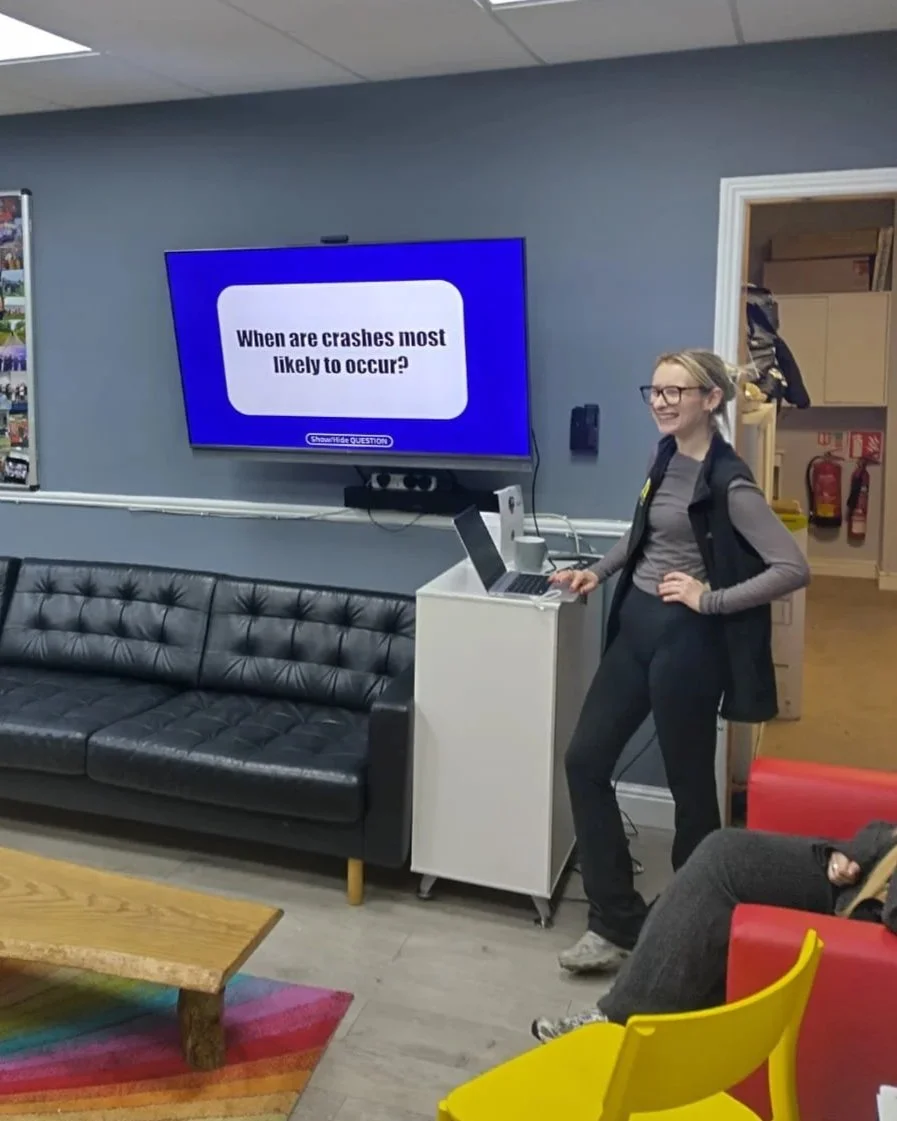
Solas Project Youth Workers facilitate Driving Safety Quiz as part of the Drivers Programme
Firstly, there must be consequences for dangerous driving. There must be consequences when people deliberately put other people's lives at risk. However, punishment is not a prevention strategy. One of the clearest findings from the research, which is reinforced through our work in Solas Project on the ground, is that punishment alone is not what changes young people’s behaviour.
One motivation for change found in the research was the prospect of being able to drive legally. As their driving bans came towards an end, their attitudes began to change. One young person said:
“I’m hoping to have my own car and my licence real soon, I’ll still like cars but I’ll be able to do it legally.”
This gives them something to work towards, a legitimate version of the thing they value. It provides a pathway from risk to achievement. In Solas Project every term we run a drivers programme targeting young people who have been involved in this type of behaviour. They engage in an educational and honest discussion around the impact of reckless driving. They work towards changing the goal reward from the negative notoriety to the positive achievement of obtaining their licence legally.
We have seen young people who were previously involved in reckless and illegal driving begin to engage with structured driving programmes, learn about cars and driving in a safe environment, and start to experience the satisfaction of doing something well without breaking the law. That is not being soft on crime. It is being serious about preventing it.
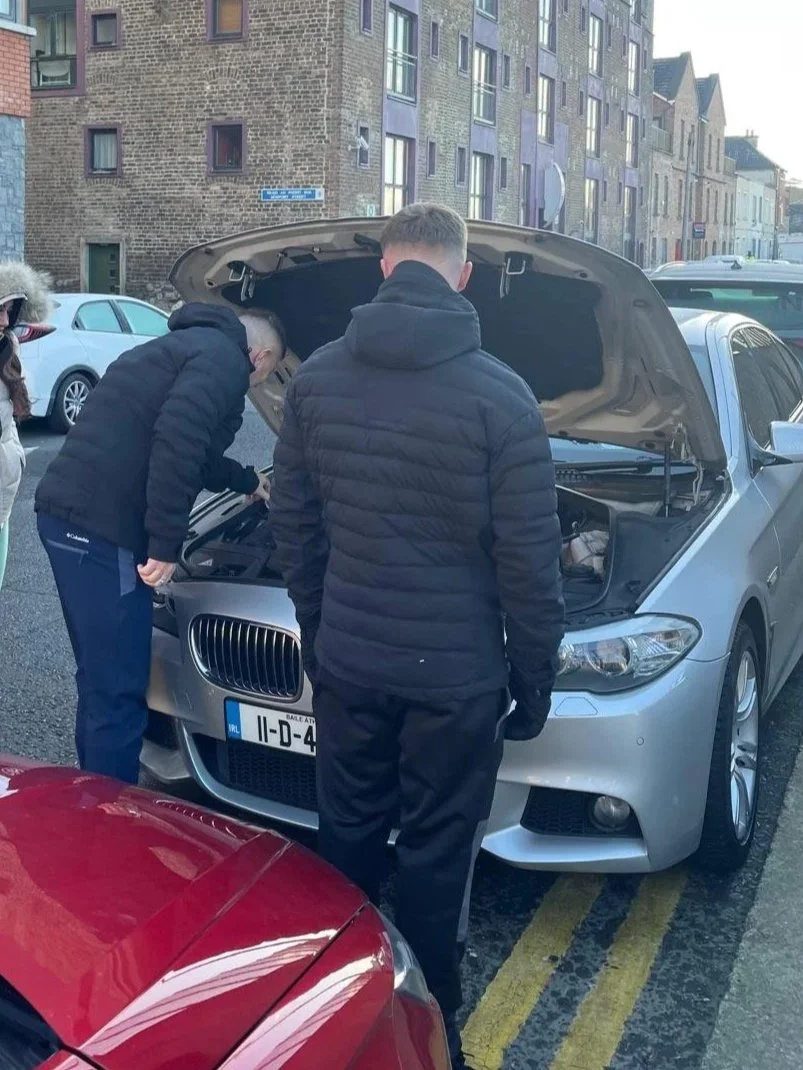
Learning about Car MAINTENANCE as part of our Drivers Programme
We need to replace the high
If driving provides excitement, we need to give young people opportunities to experience excitement safely. If driving provides achievement, we need to give them opportunities to achieve. If cars provide status, we need to give them opportunities to gain status through something positive. If stealing a car together provides belonging, we need to create healthy spaces where they can belong.
For some young people, reckless driving is filling a very real gap. That doesn't make it acceptable. But understanding this gap gives us a better chance of filling it with something safer and positive. Critically, it could stop the next group of young people from deciding to get behind the wheel in a reckless way. It is not about rewarding bad behaviour, it's about preventing the harm in the first place.
We cannot punish our way out of this
There will understandably be calls now for tougher laws, stronger enforcement and greater Garda resources. Some of those responses may be necessary, but they won’t put an end to reckless behaviour. Alongside the question: How do we punish the next young person who does this? We need to also ask: How do we stop the next young person from wanting to do it in the first place?
If we want to end this behaviour and prevent future tragedies, we need to invest in young people before they become deeply entrenched in offending. We need to tackle social exclusion. We need to keep young people connected to education, employment, sport and community. And we need to recognise that masculinity, status and peer approval can be powerful drivers of behaviour, while creating healthier ways for young men to experience a sense of all three.
Stopping this behaviour means being prepared to make the extra effort to reach the young people who are hardest to reach. Because they are not only a road safety issue. They are young people. Young people who have the potential to become something else. My research shows that when young people see a future worth protecting, their behaviour can change. If we want to see change after the horrors of the last few weeks, we need to take road safety seriously. This not only means holding people accountable for dangerous behaviour, it means putting real actions in place to prevent young people from reaching the point where reckless driving becomes their source of identity, belonging and achievement.
Punishment is often too late to save lives.
When the stakes are this high, prevention has to be worth trying.


